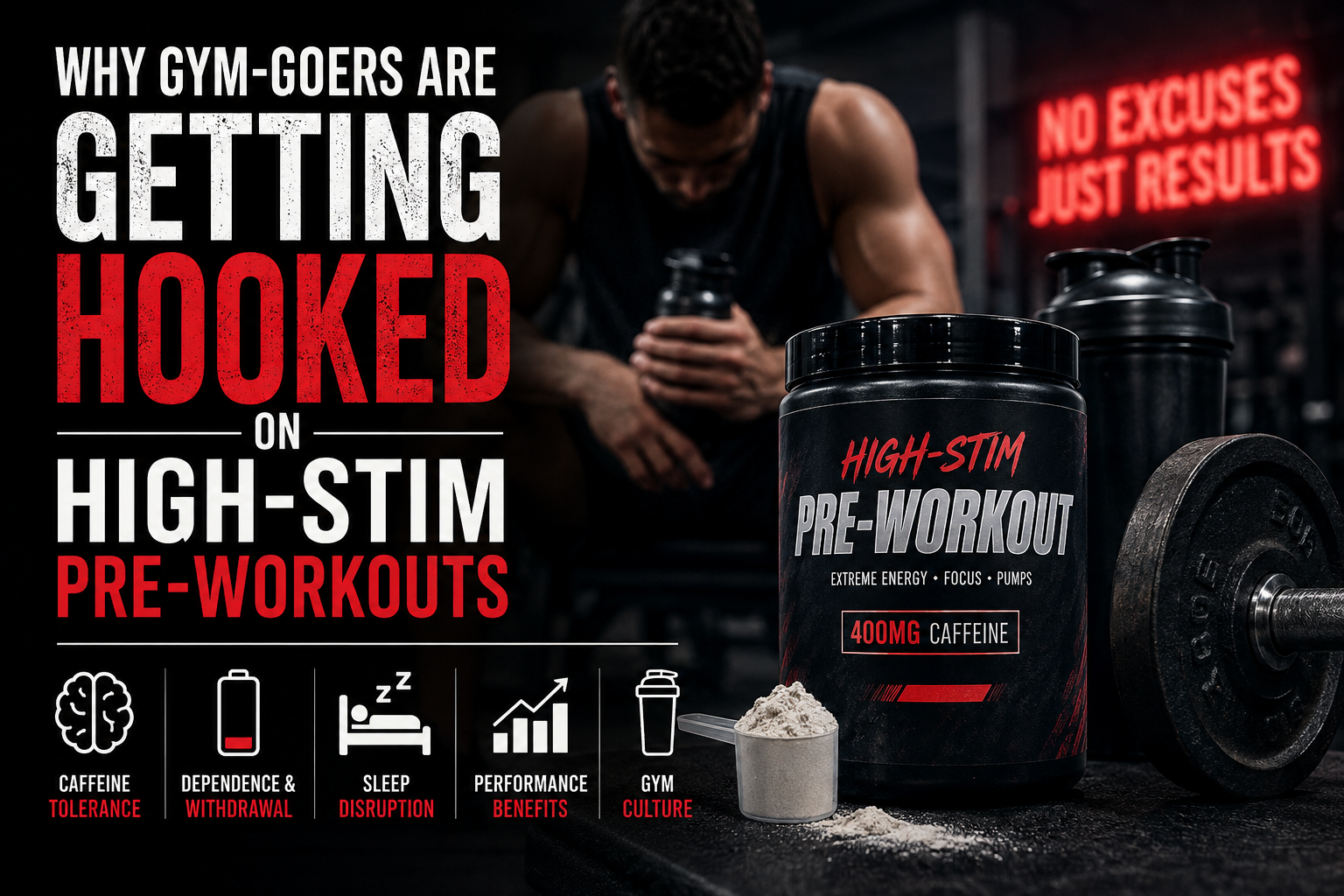
There is a point in your gym life when 200 mg of caffeine sounds like a lot. Then 300 mg starts looking normal. Eventually you see a pre-workout containing 350 mg, 400 mg or more and, instead of asking, “Why would anyone need that?”, you start wondering: “How good would my workout feel on that?”
Welcome to the strange world of high-stim pre-workouts. People do not keep coming back simply because gym-goers are reckless or obsessed with colourful powder. The uncomfortable truth is much simpler: high-stim pre-workouts can make training feel really good. Caffeine can genuinely improve aspects of exercise performance, which is precisely why the relationship between lifters and increasingly strong pre-workouts deserves a closer look.
Calling every regular pre-workout user “addicted” would be inaccurate. The better-established issues are caffeine tolerance to some effects, physical dependence, withdrawal, sleep disruption and the behavioural ritual that can develop around taking a pre-workout before training.
On this page
- Why the first workouts can feel incredible
- You get hooked on the workout first
- Why people start looking for stronger formulas
- What happens when you train without it
- The 400 mg problem
- How gym culture makes it worse
- The sleep-stimulant loop
- What about the crash?
- Is this actually addiction?
- Do you need to quit pre-workout?
- Bottom line
- Sources
Why the first high-stim workouts can feel incredible
Imagine finishing a long day when the gym sounds less like something you want to do and more like another job waiting for you. You start negotiating with yourself: maybe skip today, maybe do a light session, maybe train tomorrow. Then you take your pre-workout.
Later, the conversation changes. The music feels better, you stop scrolling, the warm-up no longer feels like a chore and suddenly you are attacking the session you nearly skipped. That experience is not completely imaginary. Caffeine has a substantial evidence base as an acute exercise-performance aid and can improve several aspects of performance in many, though not all, people.
So when someone says, “I train better after pre-workout,” they may genuinely be right. That is exactly what makes high-stim products so interesting: the product can actually work.
You don't get hooked on the powder first. You get hooked on the workout.
This is the part supplement labels rarely discuss. Your brain starts making associations. Hard leg day? Pre-workout. Feeling tired? Pre-workout. Heavy bench session? Pre-workout. Trying for a personal best? Definitely pre-workout.
Eventually the taste itself can become part of the training ritual: headphones, gym bag, shaker, scoop, music, go. You are not necessarily thinking, “I need caffeine.” You are thinking, “I need to get into gym mode.” The scoop becomes the switch between normal life and training.
That association matters because the expectation and ritual around a product can become part of the training experience alongside the pharmacological effect of caffeine itself.
Then the old pre-workout doesn't “hit” anymore
Remember the first time a strong pre-workout absolutely slapped you? The energy, urgency and feeling that resting between sets was wasting valuable time can be memorable. But the subjective experience of caffeine does not necessarily remain identical with habitual use.
Regular caffeine exposure can produce adaptation and tolerance to some effects, although the relationship between habitual caffeine intake and exercise performance is more complicated than saying caffeine eventually “stops working.” Research does not show that every habitual caffeine user simply loses all performance benefit.
But gym culture has a very simple answer when somebody says their old pre-workout no longer feels exciting: buy something stronger.
Two hundred milligrams becomes 300. Three hundred becomes 350. Then somebody mentions a product with roughly 400 mg and suddenly a number that once sounded extreme starts looking like an upgrade.
Then you try training without it
One day you skip the scoop and the workout feels terrible. You are tired, your head hurts, motivation is missing, concentration is poor and everything feels heavier. The obvious conclusion is: “See? I need pre-workout.”
Except that may not be the whole story. Habitual caffeine use can produce physical dependence, and suddenly stopping or substantially reducing caffeine can cause recognised withdrawal symptoms including headache, fatigue, drowsiness, irritability and difficulty concentrating.
That means the comparison can gradually change. It is no longer necessarily just normal you versus caffeinated you. Part of what you are experiencing may be you without your usual caffeine versus you after restoring your usual caffeine intake.
Caffeine can relieve caffeine-withdrawal symptoms. The pre-workout therefore feels like it “fixed” your energy, while part of what it fixed may have been the absence of the stimulant your body had become accustomed to receiving.
Tired → take pre-workout → feel better → train hard → associate the good workout with the scoop → repeat.
Eventually it can become: no scoop → feel flat → bad workout → “I need my pre” → take caffeine → feel better again.
The 400 mg problem
Four hundred milligrams has almost become a badge of honour in parts of the high-stim world. But this number needs context.
The US Food and Drug Administration says that for most healthy adults, 400 mg of caffeine per day is an amount not generally associated with negative effects. The important words are per day. That is not a recommendation to consume 400 mg in a single pre-workout serving, and it is not a performance target.
Individual caffeine sensitivity also varies substantially. One person may tolerate a dose that makes another person anxious, nauseous, restless or unable to sleep. Copying somebody else's stimulant intake therefore makes little sense.
The real warning sign isn't when 400 mg feels powerful.
It's when 400 mg stops feeling powerful — and starts feeling normal.
A person new to stimulants may look at 400 mg in one serving and think, “Absolutely not.” Someone accustomed to strong formulas may look at the same number and think, “Nice.”
That difference does not automatically tell us something about the quality of the product. It may tell us something about the user's relationship with stimulants. If a very large caffeine dose feels necessary simply to get switched on for an ordinary workout, it is reasonable to ask why.
Four hundred milligrams is not a magic bodybuilding number. It does not automatically mean more strength, more muscle or a better session. At some point, more stimulation simply means more stimulation.
Gym culture can turn “effective” into “extreme”
There is another ingredient in high-stim pre-workout that is not inside the tub: gym culture. Somewhere along the way, pre-workouts started being judged not only by whether they improved training but by how insane they made the user feel.
“My face was on fire.” “My hands were shaking.” “I was sweating before I touched a weight.” These stories are funny, but none of those sensations is a performance measurement.
Feeling more stimulated does not automatically mean performing better. Sports-nutrition research has consistently found that caffeine can improve aspects of exercise performance. Benefits are commonly reported around 3–6 mg/kg, while very high doses are not required to produce an ergogenic effect and are more likely to bring unwanted side effects.
The marketing problem is obvious. “Moderately dosed and evidence-based” is not nearly as exciting as a black tub covered in lightning promising extreme energy.
Where do you go after 400 mg?
This is where chasing the feeling can become a problem. The old product no longer hits, so you buy something stronger. Eventually that feels ordinary too. What comes next — another scoop, coffee on top, an energy drink or another stimulant?
The goal should never be: “How stimulated can I possibly feel?”
The useful question is: “Did this dose improve my training enough to justify taking it?”
Those are completely different ways of evaluating a pre-workout.
The sleep-stimulant loop
Here is one of the worst trades you can make in fitness: borrow energy from tonight's sleep to improve tonight's workout, then use caffeine tomorrow because you slept badly.
It happens easily. You are exhausted after work, so you take a high-stim pre-workout for a late session. The workout is fantastic. You get home, eat, shower, get into bed — and cannot sleep properly.
The next day you are tired, so you drink more caffeine. By the next workout you are exhausted again, so another pre-workout seems completely logical. Great workout, poor sleep, low energy, more caffeine, repeat.
Caffeine does not disappear when your workout ends. Its biological half-life is measured in hours, and metabolism varies substantially between individuals. That means a meaningful amount of caffeine from a strong evening pre-workout can still be circulating when you are trying to sleep.
A pre-workout that creates an incredible late-night session can therefore still be a bad trade if it repeatedly damages the sleep that follows. A proper pre-workout review should not end when the final set ends. It should ask two questions: How was the workout, and how was the rest of the night?
What about the “pre-workout crash”?
Some users describe feeling flat, tired or headachy after the stimulation wears off. Not everyone experiences this, and the cause is not necessarily one simple chemical “crash.” Sleep, food intake, hydration, training fatigue, habitual caffeine use and the total stimulant load across the day can all contribute to how someone feels later.
The problem begins when the automatic response to feeling flat is more caffeine. Morning coffee because you are tired, afternoon caffeine because energy is dropping, then pre-workout because you need to train. At that point, asking how much caffeine is in the pre-workout misses the bigger picture.
The more useful question becomes: “How much caffeine am I consuming across the entire day?”
This does not mean pre-workout is bad
Discussions about stimulants often become unnecessarily binary. One side says pre-workout is dangerous garbage. The other says they have taken it for years and are perfectly fine. Neither position tells us much about how an individual should actually use caffeine.
Caffeine can genuinely improve exercise performance. A well-formulated pre-workout can be convenient. Some people tolerate caffeine better than others, some train early enough that sleep is less of a concern, and some reserve high-stim products for occasional demanding sessions rather than using them every day.
There is nothing inherently wrong with enjoying a strong pre-workout. The problem is losing track of why you are taking it.
Ask yourself one simple question
Could you have a good workout tomorrow without it?
Not your best workout ever. Not a personal-record attempt. Just a normal, productive training session.
If the answer is “of course,” your pre-workout may simply be a performance tool you enjoy.
But if the answer is “without it I feel terrible,” that deserves more thought. Maybe you are underslept. Maybe your total caffeine intake is high. Maybe suddenly removing caffeine produces withdrawal symptoms. Maybe the ritual has become so strongly connected with training that the gym feels wrong without it. Or several of those things may be happening together.
Before buying an even stronger tub, figuring that out may be more useful than adding another 100 mg of caffeine.
Is this actually addiction?
The word “addiction” needs care. Calling every regular high-stim pre-workout user addicted would be inaccurate. What is much better established is that habitual caffeine consumption can lead to physical dependence and that abrupt reduction can produce a recognised caffeine withdrawal syndrome.
There can also be a behavioural component around pre-workout use: the taste, anticipation, scoop, music and association between taking the product and having a serious training session.
So when somebody says, “I literally cannot train without my pre,” there may be several explanations: caffeine's genuine performance effects, withdrawal, habit, expectations, poor sleep or years of making the pre-workout ritual inseparable from training.
That is why “hooked” can describe the culture without casually diagnosing every regular user with a clinical addiction.
Do you need to quit pre-workout?
Not necessarily. This is not an anti-pre-workout argument, and there is no need to dramatically throw a perfectly usable tub in the bin simply because you enjoy caffeine.
A more useful approach is to stop treating every workout like a national emergency. Some sessions may genuinely benefit more from extra stimulation: an early-morning workout, a demanding training day or competition. An ordinary session may not require the strongest formula available.
Some workouts can involve less caffeine. Some can involve none. That is not because stimulant-free training is morally superior; it is simply useful to know that you can still train productively without needing extreme stimulation every single time.
Why high-stim pre-workouts are so difficult to judge
The product can actually work. That is what makes this topic interesting. If high-stim pre-workouts did absolutely nothing, people would not develop such strong relationships with them.
They can increase alertness. Caffeine can improve aspects of exercise performance. The flavour, ritual, music, focus and energy can make training genuinely more enjoyable.
But something can be useful and still be overused.
The question is not: “Is pre-workout good or bad?”
The better question is: “Am I using pre-workout to improve my training, or has pre-workout become something I need just to make normal training feel possible?”
Bottom line
High-stim pre-workouts became popular for a simple reason: they can make training feel incredible. The energy can be real, caffeine's performance benefits can be real, and the ritual can make a difficult workout much easier to start.
But caffeine dependence and withdrawal are real too, tolerance can affect some responses, and late stimulant use can create an ugly relationship between training, sleep and tomorrow's energy.
So if 200 mg used to feel powerful, 300 mg became ordinary and now you are searching for 400 mg simply to recreate the feeling you used to get, buying an even stronger pre-workout may not be the smartest upgrade.
Sometimes the smarter move is figuring out why the old dose stopped feeling strong in the first place.
The most interesting thing about a high-stim pre-workout isn't how hard the first scoop hits.
It's what happens when it doesn't hit anymore.
Sources
- Guest NS, VanDusseldorp TA, Nelson MT, et al. International Society of Sports Nutrition position stand: caffeine and exercise performance. Journal of the International Society of Sports Nutrition. 2021. DOI: 10.1186/s12970-020-00383-4
- Juliano LM, Griffiths RR. A critical review of caffeine withdrawal: empirical validation of symptoms and signs, incidence, severity, and associated features. Psychopharmacology. 2004. DOI: 10.1007/s00213-004-2000-x
- US Food and Drug Administration. Spilling the Beans: How Much Caffeine is Too Much? FDA caffeine guidance
This article discusses high-stimulant pre-workout culture using published research on caffeine, exercise performance, dependence and withdrawal. The Smart Buyer UAE did not conduct the cited clinical research. Individual responses to caffeine vary considerably, and this article should not be treated as personalised medical advice.
Last reviewed: 11 August 2026.